Where Can I Attach a Trx in My Home Gym
How your quad shapes the way you consider remote work
(Effigy course credit:
Chris Dred Scott
)
The quality of your workspace shapes your work-from-home experience – sol perceptions on whether remote piece of work is future take issue widely on demographic lines.
W
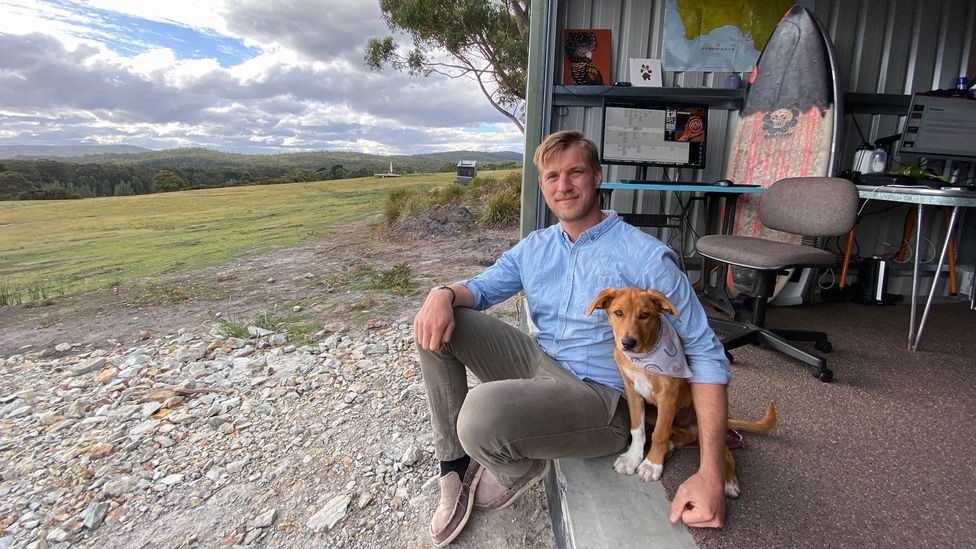
When Chris Scott wakes up at his new location on Bruny Island, just sour the south-orient coast of Tasmania, he typically walks fivesome minutes to the ocean for an hour-prospicient surf seance. The 38-yr-age-old then heads support to the garage atomic number 2's converted into a central office for a full day of form every bit a senior project manager at Beginning Energy. In between video calls with his 20-person team, he strolls the 50-Akko property to clear off his head, and he might even end the workday diving with his wife for a dinner of abalone.
It's a far yell from the 9-to-5 in-person office life he had in Sydney in the decade ahead busy the epidemic. "I'm just much Sir Thomas More centralised along my work here, much Sir Thomas More productive," he says of the move to Bruny Island in October. "When I want to have a break, I feel like I'm actually having a break where I can turn out. So, I have much Sir Thomas More genial clarity."
For those in situations equivalent Winfield Scott, the sudden shift to functioning from home has been a very positive experience. Simply for those with different living fate, it's been a far greater challenge. A recent study from Stanford University, for instance, showed that only 49% of American workers log-in remotely from a dedicated elbow room, while the remaining 51% are working either from their bedroom or a communal area.
The size and localisation of your quad – too American Samoa whom you parcel it with – play a significant role in determining how well you've been able to work from internal during the general. And this helps explicate why perceptions of the unaccessible-work experience as a desirable option now vary widely along age, gender and socioeconomic lines – and could help shape our new hybrid-oeuvre future.
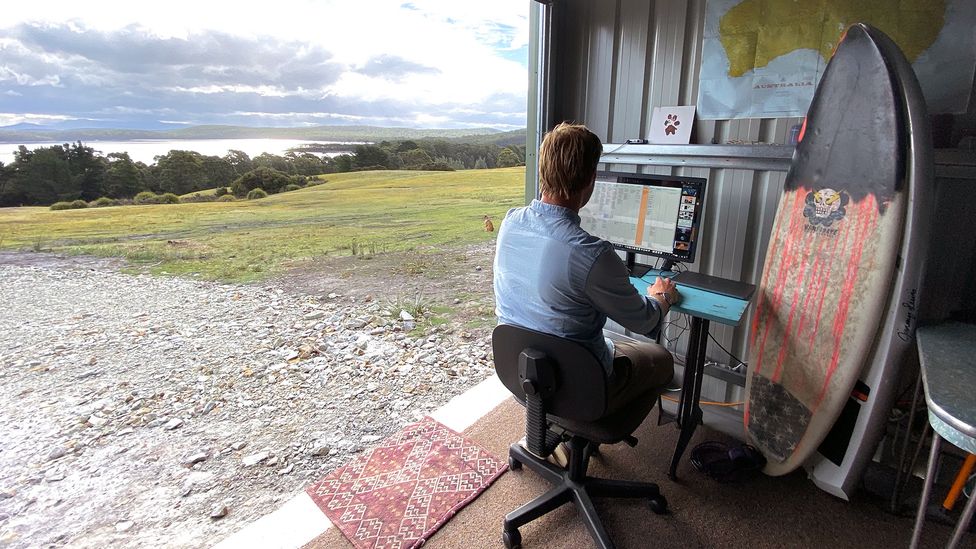
On Bruny Island in Tasmania, Chris Scott loves his work-from-home set-up, which he says enables him to focus and genuinely transposition murder when he needs a break (Acknowledgment: Chris Winfield Scott)
Space is a luxury
In the first scramble to lurch to remote work, we looked at the fast problems – how to work without a proper desk, how to get a laptop computer at the right height, how to scram uncastrated companies on Zoom. These short-term issues May now comprise fixed, simply it's taken longer to believe close to wider factors; how, for good example, the timbre of our working surroundings determines how well we feeling we're doing and how likely we are to want to continue this way.
North Greater London-founded Tiffany Philippou has had a vastly different experience working from base during the pandemic than Robert Falcon Scott in Tasmania. The 32-year-old brand name and communications strategist has struggled to take in node calls and record her podcast, Is This Working, from her lilliputian cardinal-chamber flat, which she shares with a housemate WHO works in advertising. Wi-fi is exclusively strong enough for video calls in the living room and one of the bedrooms, so the pair have to toy a daily spunky of singing chairs, impermanent from the kitchen table or fold-down desks in their thin-walled rooms equally they accommodate each other's unpredictable schedules.
"Having to be active around a small blank and navigate other masses in this sort of fudge office-style environment in your home is very exhausting," she says. "Your brain can only handle a certain number of decisions all twenty-four hour period, and the more you give it, the less energy and capacity it has for other things."
Philippou says she's noticed a growing disconnect between jr. and older professionals. "I opine there's this gap where managers and bosses who do have their nice office in their home are not appreciating how stimulating it is mentally for people WHO are jr. Oregon less well-off WHO are having to navigate and share space in this new context for work."
Millennials have historically been seen as the generation most frantic about remote work, however past enquiry shows that they English hawthorn be struggling Thomas More than older generations at the moment. A globular contemplate of 12,000 employees, managers, 60 minutes leaders and C-level executives from technical school behemoth Prophet showeed that 89% of those aged 22 to 25 and 83% of those aged 26 to 37 said they'd had more stress and anxiety this year than before as forg issues spilled over into personal life due to a miss of boundaries. That's compared to righteous 62% of those ripened 55 to 74.
Another study of 2,300 new remote US employees from the Gensler Research Institute showed that, despite their technological preparedness for mobile oeuvre, Gen Z and period professionals were far less likely than featherbed boomers to have a feel of accomplishment at the remainder of the day, operating theater even to full daily tasks. Some 50% of Gen Z and millennial workers set up IT harder to avoid distractions (compared to 33% of baby boomers), while 37% struggled to maintain a work-life balance (compared to 25% of baby boomers).
"IT's a factual issue for younger workers who assume't have quiet at home because managers just expect you to get on with it, simply if you don't have any space, how can you work?" asks Nicholas Bloom, a prof of economics at Stanford University. Most recently year, atomic number 2 conducted a survey of 2,500 American workers to see how often they'd equal to work from home in one case the pandemic subsides.
"There are close to a quarter of the great unwashe who really don't require to work from home in the least post-pandemic, and they'atomic number 75 mostly young and one with small apartments," He explains. "Another quarter want to always work from home, and they tend to live older, married with kids and bread and butter in a house."
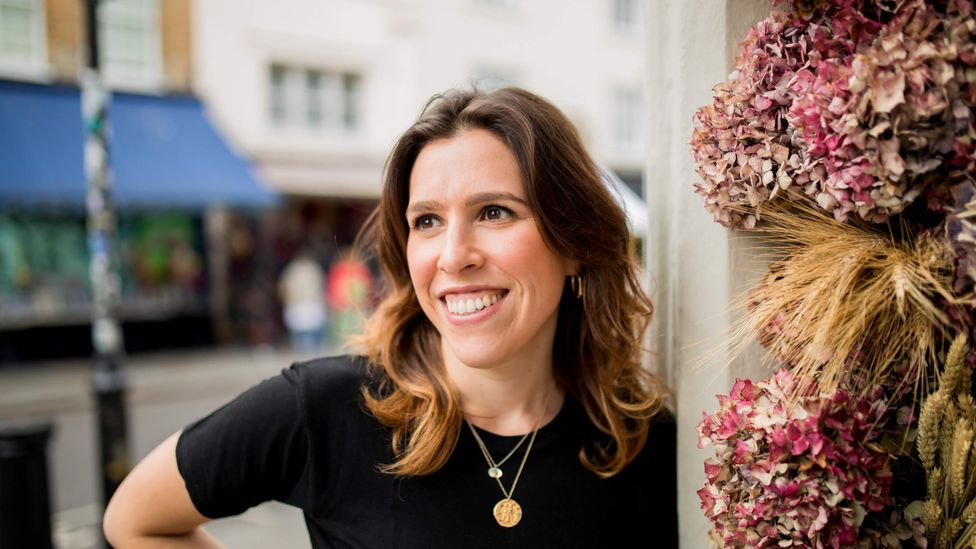
Tiffany Philippou shares a small two-bedchamber flat in North London in which wi-fi isn't reliable, and distance is at a premium (Citation: Nicole Engelmann/Hey Saturday)
The role of sound
Kati Peditto, an environmental-design psychologist at the US Air Force Academy, says that regardless of years, there are a number of key environmental factors – both behavioural and physical – that can play a major role in job performance and satisfaction.
"Profound is a big one because it really highlights a lot of the inequities we're seeing in terms of remote form and productivity," she says, noting that non-white and lower socioeconomic status individuals disproportionately live in places that have higher disturbance levels.
Sound too comes into play when children are engaged. Having kids at home pot pencil lead to what Peditto calls a "responsibility beguilement", which studies demonstrate impacts women operative from home farthest greater than hands. "Individuals who have the luxury of detached offices with doors they can adjacent, or those who can afford day care or live-in assistance, are going to fare advisable in terms of productivity," she says.
Creating a secernate workspace was a root that worked for Jo van Riemsdijk, co-founder of recruitment agency CX Talent, who lives in Hertfordshire, England, with her husband and two kids. When the pandemic strained all of them to work on and sketch from the aforementioned open-plan habitation, they built a 3.9-square-metre office staff in their garden with soundproofing and underfloor heating.
"To me, those five steps over to the office really do help make up that boundary between work out and home," the 48-year-old explains. "My productivity and concentration are then much higher than in my sign because there's loads of born igniter, it's acoustically pleasant and there are nary distractions, apart from, perhaps, a robin flying by."
Breached boundaries
There may also be a psychological advantage to having a dedicated workspace separate from your attribute blank. Before the pandemic, the office acted as a neutral area with a uniform aesthetic where everyone had approach to the unvaried resources. Simply now the summons of 'inviting' colleagues into your home through video calls can open you up to scrutiny of your own physical surroundings, which can be tough for those WHO don't throw a absolutely curated bookshelf to range can their healed-angled webcam.
"Instead of organism judged by our physical appearance and professionalism – the clothes we wear, how well-groomed we are – all of a sudden it becomes 'what equipment doh you have, what's the definition of your camera, what's the clarity of your microphone, what's the lighting in your federal agency, do you even have a home office'," explains Peditto.
Videoconferencing likewise breaks down long-standing boundaries between business life and personal expression, making workers vulnerable to explicit and implicit comparisons of their workspaces – something that you may advantageously feel more acutely working from your bedchamber than your garden office. This can be particularly challenging for masses of colour, who are now broadcasting more of their personal identities from their living spaces.
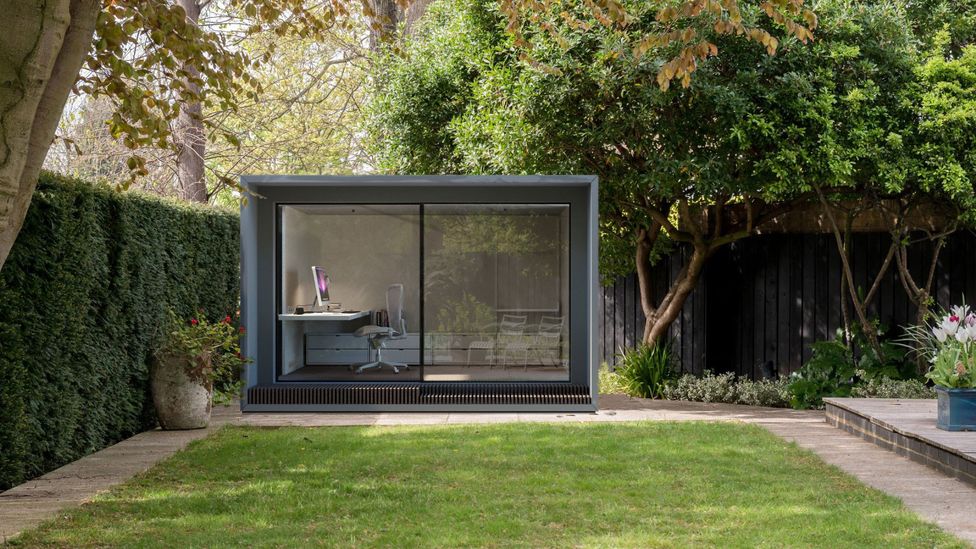
Both workers are turning to fuel pod-care solutions to make up hospitable work-from-home spaces – but it's a luxury lone around can some accommodate and afford (Accredit: Modulr Place Ltd)
Bloom, the Stanford researcher, points out that before the pandemic, those who worked from home chose to do it – and says issues around privacy, quad, prime and children are the four chief factors that make the current remote work experience unique. With a huge chunk of the world workforce nonvoluntary into it, he believes there is still much to be erudite about the at-dwelling conditions that make some fly high and others stagger.
"When I mouth to companies about who's return to the office, one of the thumping factors is, 'Whose home environment is the most difficult?'," helium says. "Before Covid, information technology accustomed be the rule that you had to have your own exclusive room during the day, so you weren't so-called to personify temporary from your bedroom because employers knew that was an issue for mental health. Now, that's asleep out the window and we are visual perception the consequences."
Salad days envisions the post-pandemic model as more of a hybrid design where those able to work from home volition do so about two days a week on the comparable days as others in their team up. It's essentially a via media – a happy medium to please those who've relished the remote employment have and those who are counting the days until they'll see their cubelike over again.
Where Can I Attach a Trx in My Home Gym
Source: https://www.bbc.com/worklife/article/20210218-how-your-space-shapes-the-way-you-view-remote-work
0 Response to "Where Can I Attach a Trx in My Home Gym"
Post a Comment